

Perquimans County occupies the north shore of the Albemarle Sound in the far northeastern corner of North Carolina, and the paper trail on it starts unusually early. The oldest surviving land deeds in the state were signed here, on a point of land jutting into the sound between two rivers, more than a decade before the county existed on any map.
1661–1662 The Durant Deeds
On August 1, 1661, George Durant — one of a handful of Virginians trapping and trading along the southern edge of the colony — purchased a point of land from Cisketando, "King of the Yeopim," between the Perquimans River and the Little River. A second deed followed on March 4, 1662, with Kilcocanen conveying the same neck of land in the Yeopims' own name1. Both deeds were later recorded, in 1716, and they survive today as the oldest existing land deeds in North Carolina. The ground itself — then called Wikacome, now Durants Neck — sits in present-day Perquimans County, and a state historical marker (A-3, "George Durant") stands in the town of Hertford to mark it.
Durant went on to become Speaker of the colonial assembly. Two other early arrivals, Nathaniel Batts and John Harvey, were trading and trapping the same stretch of coast around the same years, but it is Durant's paper — two deeds, a decade before any government existed to record them — that anchors the county's documented history.
Two deeds, a decade before any government existed to record them.
The land itself carried a name before Durant ever bought it. The Yeopim, a subtribe of the Weapemeoc who lived along this shore, are credited by at least one published county history with calling it Perquimans — commonly translated as "the land of the beautiful women."2 That translation is worth flagging rather than repeating as settled fact: NCpedia's own entry on the county states only that it was later named for the Perquimans Indians, without offering a translation, so treat the "beautiful women" gloss as attributed folklore rather than a confirmed etymology.
1668 / 1679 A Precinct of Albemarle
Here is a case where this site's own buyer's brief already flags a genuine disagreement in the record, and the history page inherits the same caution rather than picking a side. Perquimans was organized as a precinct of Albemarle County in the late 1660s — several secondary sources, including the North Carolina History Project's own encyclopedia entry, date that organization to 1668. NCpedia's geography entry for the county gives a different date, 1679, and states it was originally called Berkeley Precinct before taking the Perquimans name.3 The National Register nomination for the Old Neck Historic District, in Perquimans County, likewise cites a "circa 1668" formation. Both dates are published by sources this site otherwise treats as reliable, and no single document has been found that reconciles them. If a listing agent gives you a firm founding year, ask which source it comes from.
What is not in dispute: Perquimans is one of the oldest counties in North Carolina, formed as one of the original Albemarle precincts alongside Chowan, Currituck and Pasquotank — the same four counties whose Buyer's Briefs, together with this one, cover the whole Albemarle region this site's own sibling sites describe.
1672–1698 The Quakers Arrive
Two traveling evangelists reached the Albemarle region within eight months of each other in 1672. The Irish preacher William Edmundson arrived in March and held what NCpedia describes as the first religious services in the colony. That November, George Fox — the founder of the Religious Society of Friends — spent nearly three weeks in the settlement, leading worship, meeting with the governor, and preaching to the local Indians.4
Tradition holds that the earliest meeting for worship in North Carolina was established in present-day Perquimans County, at the home of a settler named Francis Toms — and that the same site hosted the first meeting, in 1698, of the North Carolina Yearly Meeting, which NCpedia calls "the oldest extant religious organization in the state."5 The earliest surviving Quaker meeting records in North Carolina, dating to 1680, are from the Perquimans Monthly Meeting. A state historical marker (A-79, "Quaker Activity") stands at the US 17 Business bridge over the Perquimans River, marking the 1672 visits.6
The oldest continuously operating religious body in the state traces itself to a farmhouse on the Perquimans River.
Past Meets Present
The Quaker settlers who farmed this ground rather than shipping through it are a real part of why Perquimans reads today as agricultural rather than commercial — and it is also, not coincidentally, why the entire county sits inside USDA's eligible rural service area. A buyer using USDA's zero-down loan program here is borrowing against the same rural character the 1672 arrivals came looking for.
1730 The Newbold-White House
The county's best-known building sits on the west bank of the Perquimans River, outside the town of Hertford, and its documented age has been corrected once already. For years it was believed to date to as early as 1685. In 1994, dendrochronology — dating a structure by analyzing its own rafter timbers — fixed construction at 1730, built for the Quaker couple Abraham and Judith Pricklove Sanders.7 It was added to the National Register of Historic Places on June 24, 1971.
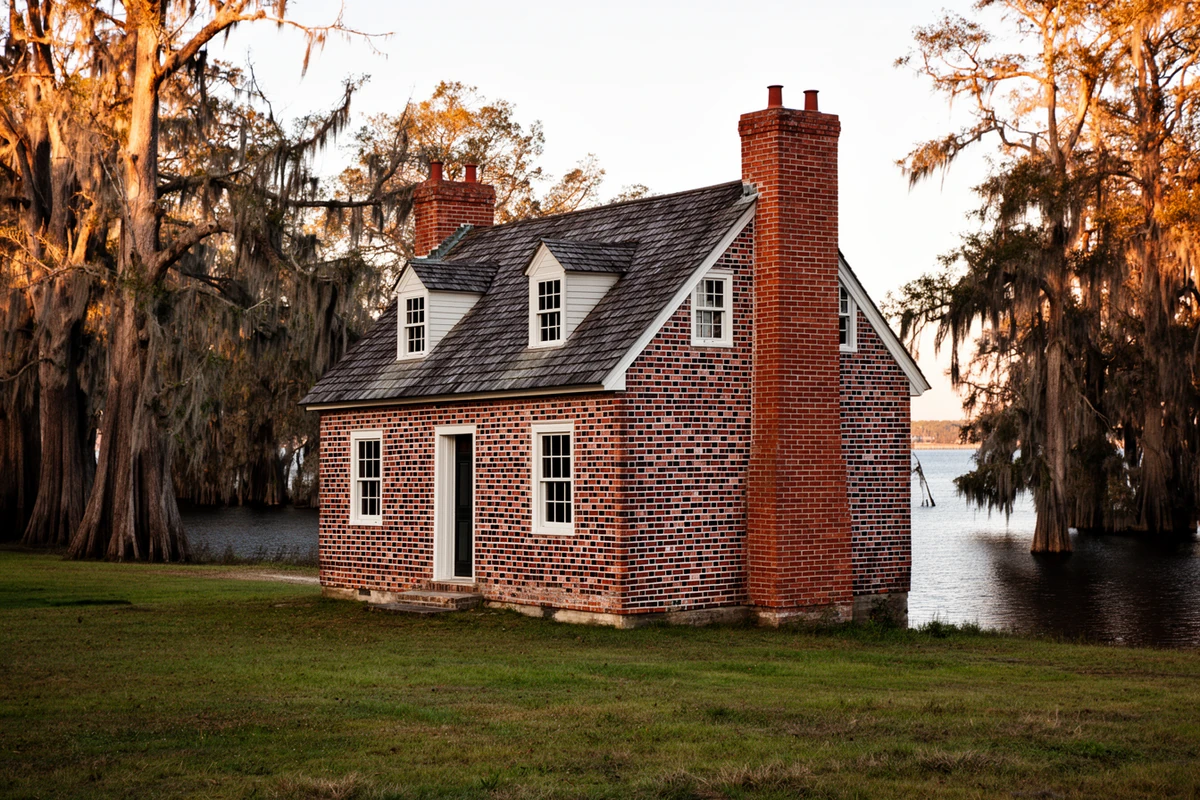
It is widely described as the oldest brick house in North Carolina — the Perquimans County Restoration Association, which has owned and operated it since 1973, calls it "recognized as the oldest brick house in the state," and VisitNC repeats the claim. NC SHPO does not publish that superlative itself; the 1971 nomination says only that the house is "one of the most important architectural landmarks in North Carolina."8 That is worth attributing rather than asserting, the same way this site's own buyer's brief treats it — a real distinction, not a hedge for its own sake. It is not a state historic site; it is nonprofit-operated and open Saturdays only, May through October.
1758–2003 Hertford, Winfall & Belvidere
The county's documented towns did not arrive with the precinct. The settlement that became the county seat spent decades as a landing point before it had a permanent name.
Phelps Point Becomes Hertford
What is now the town of Hertford was originally called Phelps Point, after a local landowner named Jonathon Phelps. The North Carolina General Assembly incorporated it in 1758 and named it after Hertford, England — the same source of the name that a separate county 45 minutes west, Hertford County, drew on independently, which is the root of the naming collision this site's own buyer's brief spends its first chapter untangling.9 The town's own official history calls it "North Carolina's seventh oldest town." A single settlement, in other words, carried a landowner's name, then a borrowed English town's name, inside one incorporation — a naming sequence with real parallels in several of this site's Albemarle-region sibling towns, each arriving at its own name by its own route.
Winfall
Immediately north of the town of Hertford, across the river, sits Winfall — small enough to function today as part of the same community. Winfall's own National Register historic district was listed in January 2003, and its municipal tax rate happens to match Hertford's exactly.
Belvidere
Belvidere, in the northwest of the county, was never incorporated, but it carries a National Register historic district of its own — listed in June 1999 — and a long Quaker history of its own, distinct from the Perquimans Monthly Meeting narrative above. Beyond these three names, the county is farmland, woods, and water frontage on the Perquimans River and its creeks.
1929–2022 The Swing Bridge
The S-shaped swing bridge carrying US 17 Business over the Perquimans River at the town of Hertford is the county's signature landmark, and its history is frequently published wrong. NCDOT's own figure for the original span — Bridge No. 8 — is 1929 (most contemporary news coverage says 1928). By 2015 its sufficiency rating had fallen to 3 out of a possible 100. The span was removed in July 2021.10
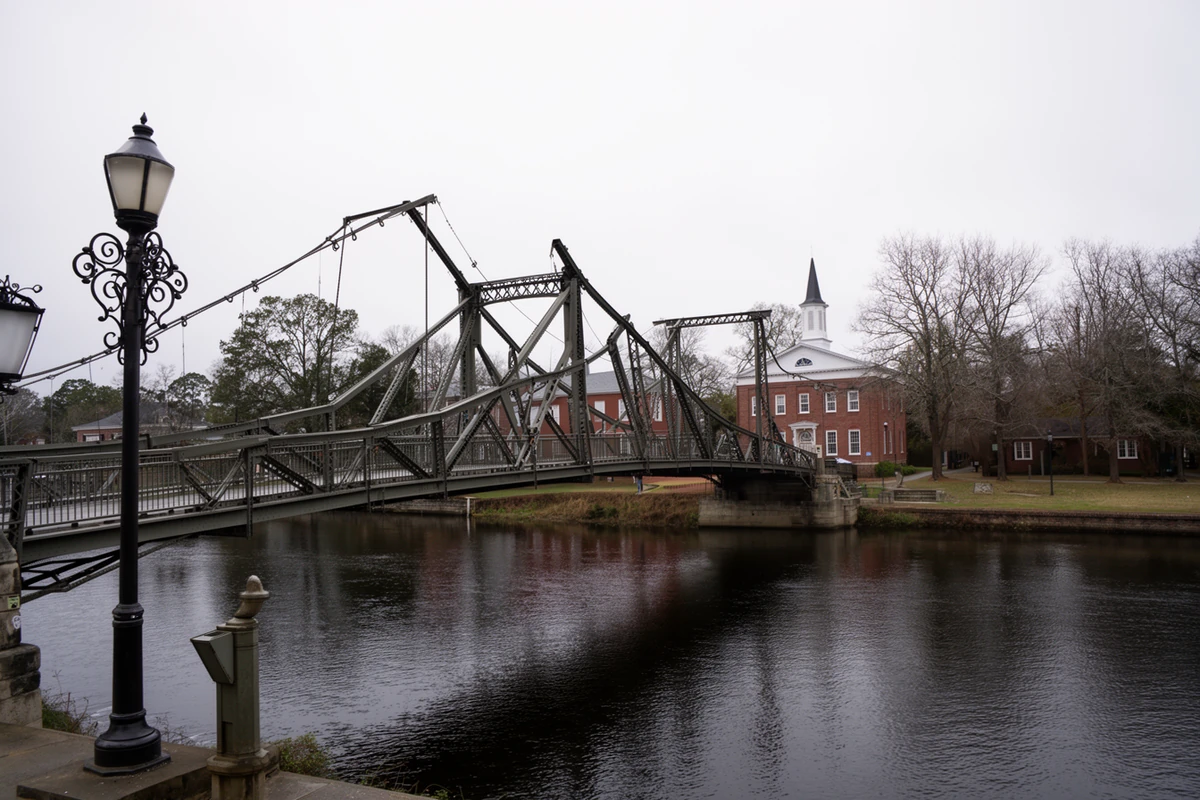
The bridge standing there today is a 2022 replacement. A Section 106 memorandum of agreement, signed in November 2017, required the new structure to carry a truss swing span, Oregon rails and decorative pedestrian lights matching the town's own streetlights, and to reuse the original bridge plaque — a deliberate echo of the 1929 structure, built new. It is still a working drawbridge, opening on signal under federal regulation.
The bridge standing there today is a deliberate echo of the one that stood there for ninety-two years, not the bridge itself.
Past Meets Present
Anyone telling you the historic 1929 swing bridge is still in service is repeating a stale web page — a small factual point with a real consequence, since this site's own waterfront chapter uses the bridge's clearance and opening schedule to explain what a boat owner can actually get up the river today. The landmark is genuine; the specific structure under it is not the original.
1971–2025 Nineteen Listings, Five Districts
Per the North Carolina State Historic Preservation Office's own roster, Perquimans County carries nineteen properties and districts on the National Register of Historic Places — eighteen of them still standing. Five are districts rather than single buildings: Old Neck (listed 1996, period of significance 1813–1946), Hertford (October 1998), Belvidere (June 1999), Winfall (January 2003), and Hertford West (February 2025) — the newest listing in the county.11
What that record does and does not mean for a buyer is worth stating plainly, because it is easy to get backwards. National Register listing is, in NC SHPO's own words from its published FAQ, "mostly an honorary designation" — absent federal funds, permitting or licensing on a project, an owner "may do anything you like with your property." A separate thing entirely, a local historic district ordinance with mandatory Certificate of Appropriateness review, is what can actually restrict what you do with your own money — and that is a municipal designation, not a National Register one.12
Past Meets Present
This is not an academic distinction on this site: a buyer eyeing a contributing house in the Hertford or Hertford West districts today needs to know whether the town's own Historic Preservation Commission requires design-review approval for exterior work on that specific parcel — a live open question this site's own old-houses chapter declines to guess at, because the town's zoning ordinance is published only as unsearchable scanned images. The nineteen-listing record above is settled. Whether it comes with local review, parcel by parcel, is a phone call to Town Hall, not a fact this page can hand you.
Present The County Today
The 2020 Census counted 13,005 residents countywide, with the Census Bureau's July 2025 estimate at roughly 13,490.13 The town of Hertford itself holds about 2,000 people — small enough to walk the whole downtown, past the courthouse and the waterfront, in twenty minutes. That scale is not an accident of decline; it is close to what a county built on farming, a river, and a handful of small congregations has looked like for most of its documented history. The 1661 deed, the 1672 meetings, the 1730 house, and the 1758 town are not museum artifacts here — they sit inside a county still small enough, and still water-shaped enough, that a buyer can drive past all four in one afternoon.
Primary Sources & Further Reading
The State Library of North Carolina's encyclopedia project. Source for the county's precinct-formation date, the Quaker settlement narrative, and the Newbold-White House's dendrochronology dating.
NC State Historic Preservation Office
National Register of Historic Places roster for Perquimans County's nineteen listings and five districts, and the National Register FAQ on what listing does and does not restrict.
NC Highway Historical Marker Program
Markers A-3 ("George Durant") and A-79 ("Quaker Activity"), both sited in the town of Hertford, administered by the NC Dept. of Natural & Cultural Resources.
The town's own official history page — source for the Phelps Point naming and the 1758 incorporation date.
Sources consulted for this page include NCpedia (the State Library of North Carolina's peer-reviewed encyclopedia project), NC SHPO's published National Register roster and FAQ, the NC Highway Historical Marker Program, the Town of Hertford's own official history page, the Perquimans County Restoration Association, NCDOT's State FONSI documentation for TIP project R-4467, and the U.S. Census Bureau's 2020 Decennial Census and 2025 Population Estimates Program. Numbered citations for specific claims appear below. Where sources genuinely disagree — as with the county's 1668-versus-1679 formation date — this page says so rather than picking one silently, the same standard this site's own buyer's brief chapters are held to. Nothing here is estimated or invented.
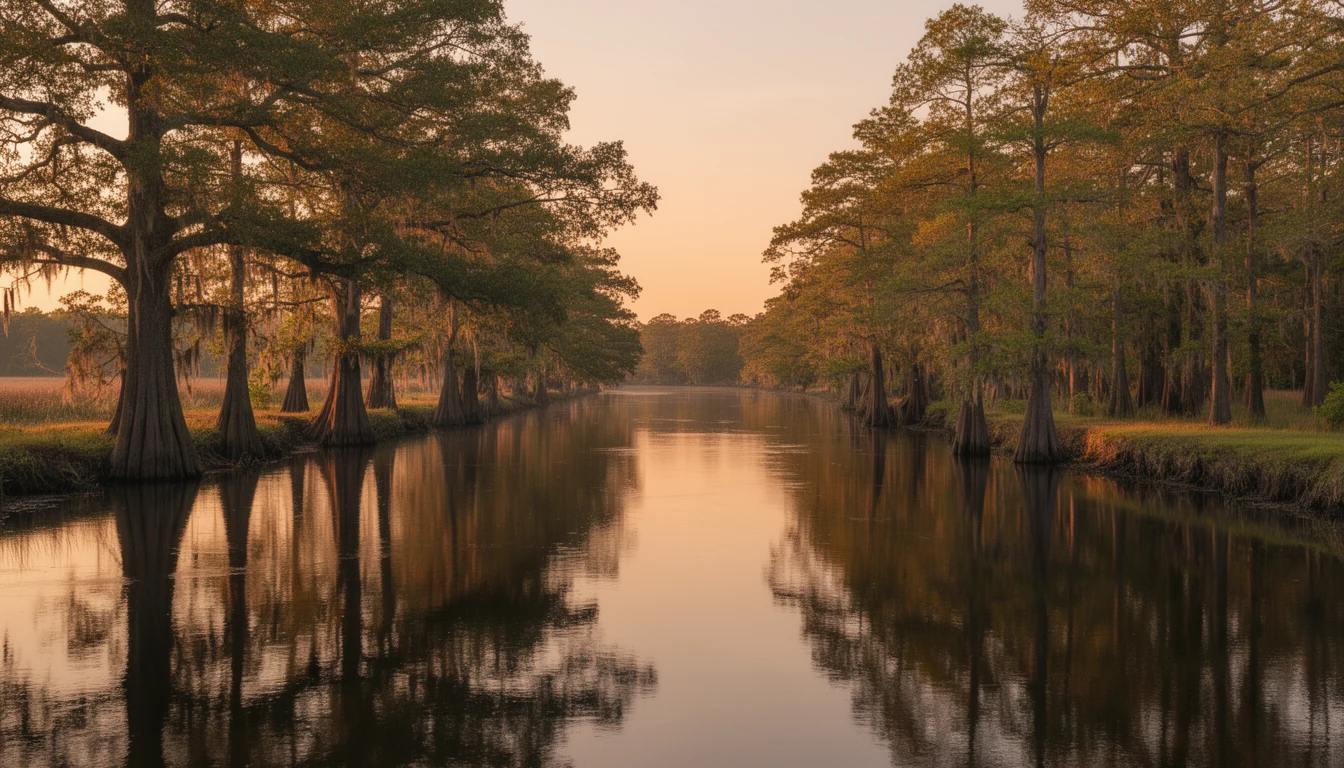
The lede photograph on this page is an illustrative landscape image, not an archival or documentary photograph of a specific Perquimans County location — this site does not yet have real photography of the county (see the buyer's brief's own open items). Treat it as atmospheric, not evidentiary.
- George Durant's August 1, 1661 and March 4, 1662 deeds with the Yeopim chiefs Cisketando and Kilcocanen, conveying land at what is now Durants Neck — the oldest surviving land deeds in North Carolina, recorded in 1716. NC Highway Historical Marker Program, marker A-3, "George Durant," town of Hertford, erected 2003. ↩
- The "land of the beautiful women" translation of Perquimans is drawn from the North Carolina History Project's encyclopedia entry ("Perquimans County (1668)," northcarolinahistory.org), not from NCpedia, which names the source of the county's name without offering a translation — see NCpedia, "Perquimans County," ncpedia.org/geography/perquimans. ↩
- Precinct-formation dates: NCpedia, "Perquimans County" (as above), gives 1679 and the earlier name Berkeley Precinct; the North Carolina History Project's encyclopedia entry and the NC HPO National Register nomination for the Old Neck Historic District both cite a "circa 1668" formation. This page states both and does not resolve the discrepancy silently. ↩
- William Edmundson's March 1672 and George Fox's November 1672 visits to the Albemarle region, per NCpedia, "Quakers," ncpedia.org/quakers. ↩
- The Francis Toms home as the traditional site of North Carolina's earliest Quaker meeting for worship and the first 1698 North Carolina Yearly Meeting, plus meeting records surviving from 1680, per NCpedia, "Quakers" (as above). ↩
- NC Highway Historical Marker Program, marker A-79, "Quaker Activity," sited at the US 17 Business bridge over the Perquimans River, erected 1993. ↩
- Newbold-White House construction dated to 1730 by 1994 dendrochronology analysis, correcting an earlier ca. 1685 estimate; built for Abraham and Judith Pricklove Sanders. NCpedia, "Newbold-White House," ncpedia.org/newbold-white-house. ↩
- Newbold-White House National Register listing, June 24, 1971 (NC HPO file PQ0005); the "oldest brick house in North Carolina" description is attributed to the Perquimans County Restoration Association and VisitNC, not asserted by NC SHPO's own nomination text, which calls it "one of the most important architectural landmarks in North Carolina." ↩
- The town's original name, Phelps Point (for landowner Jonathon Phelps), its 1758 incorporation, and its naming for Hertford, England: Town of Hertford, "Our Heritage," townofhertfordnc.com/our-heritage; also per NCpedia, "Perquimans County" (as above). ↩
- Swing bridge (NCDOT Bridge No. 8) construction year (1929 per NCDOT, 1928 per contemporary news coverage), 2015 sufficiency rating of 3/100, July 2021 removal, and the November 2017 Section 106 memorandum of agreement governing the 2022 replacement's design: NCDOT State FONSI for TIP project R-4467 (January 2018) and NCDOT's Historic Bridges program pages — the same sourcing this site's own river chapter cites for this history. ↩
- National Register listing counts, district names and listing dates: NC State Historic Preservation Office's National Register listings roster, cross-checked against NPS records — the same source this site's own old-houses chapter cites. ↩
- "Mostly an honorary designation" and the National Register/local-designation distinction: NC HPO's published National Register FAQ and local historic property designation pages. ↩
- Population figures: U.S. Census Bureau, 2020 Decennial Census (DHC, table P1) and Population Estimates Program, vintage 2025. ↩