


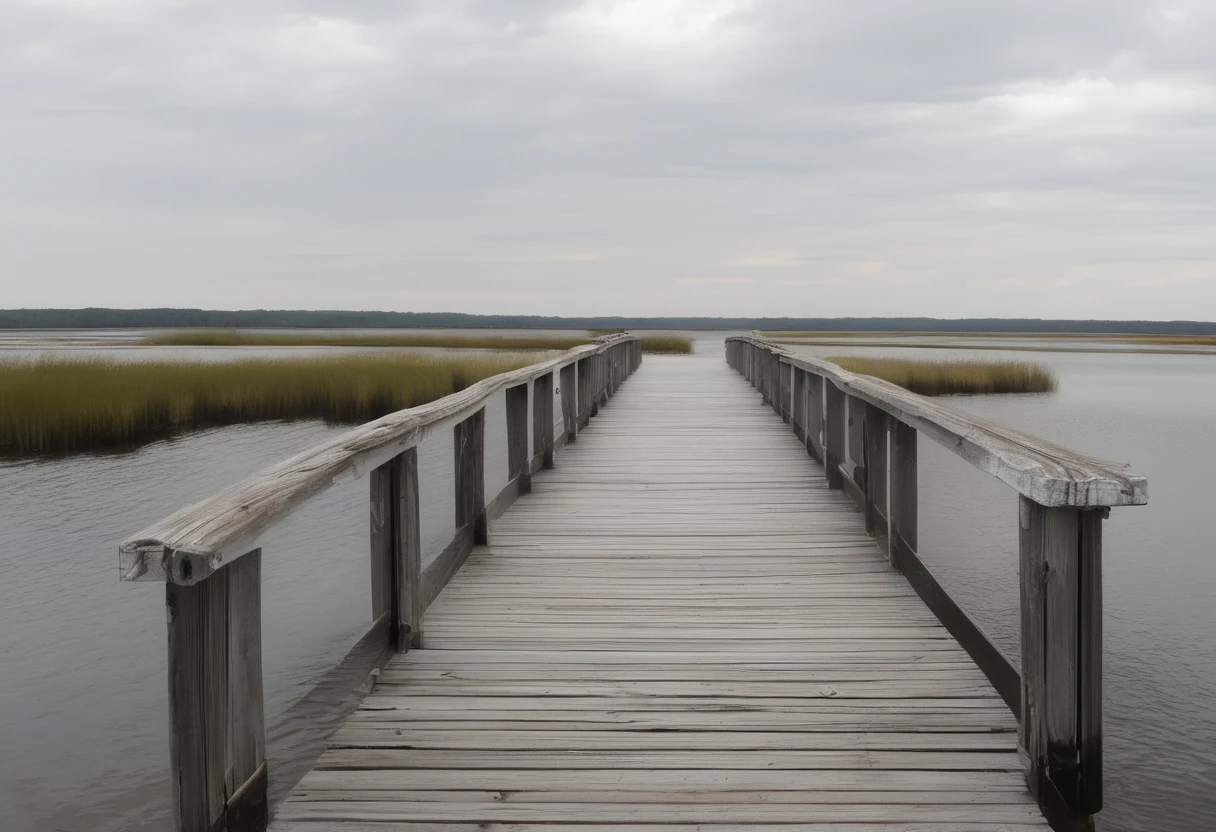
The wind has the river up. I am standing on the waterfront at the town of Hertford on a Tuesday in September, and the water is working the pilings in short, impatient sets that no tide chart would have predicted. An osprey crosses the far bank. A crab boat is tied off two slips down, and the air smells like diesel and creosote and low tide. Behind me, a truck idles at the swing bridge while a sailboat takes its time through.
If you are under contract on water in Perquimans County, that waterfront is the best classroom in the county. Everything on this list is something the water decides, not something the listing sheet decides. It is a working checklist, not legal or lending advice: your attorney, your lender and your inspector each carry a piece of this, and I am not going to pretend to be all three.
1. Get the flood zone for the parcel, not the street
Not the street. Not the neighborhood. The parcel, in writing, early.
All three NFIP communities in this county share the same current effective Flood Insurance Rate Map date: December 21, 2018. That is unincorporated Perquimans County (CID 370315K), the town of Hertford (CID 370188K) and Winfall (CID 370345K). Maps from 2018 are recent enough to take seriously and old enough that conditions on one specific parcel may have moved since. A general impression that a road is fine is not a flood determination.
2. Do not budget a Community Rating System discount
The CRS is FEMA’s voluntary program that rewards communities for floodplain management beyond the minimum, and it produces real percentage discounts on premiums. Neither the county nor the town of Hertford nor Winfall participates. FEMA’s eligible-communities list effective April 1, 2026 carries 103 North Carolina communities, 98 of them at Class 9 or better; none of them is here.
This bites buyers arriving from Dare or Hyde, where a CRS class is normal and gets assumed. Do not build a discount into your monthly number, because there is not one to build in.
3. Get the elevation certificate during due diligence
If the parcel sits in a mapped flood zone, the elevation certificate is the document that drives everything downstream: the relationship between the lowest floor and the base flood elevation. Ask the seller first, because a lot of older waterfront houses already have one on file somewhere. If nobody can produce it, commission one while you still control the calendar.
4. Price both insurance markets, then re-run the payment
Bindable quotes, in writing, before you remove your due diligence contingency. NFIP through any licensed agent, plus at least two private flood carriers. Private and NFIP pricing diverge in both directions depending on elevation, and you will not know which one wins for your property until you ask both.
Then do the part people skip: add the real annual premium to the monthly math and re-run your debt-to-income. A house that works at the list price does not automatically work at the list price plus insurance.
5. Ask the neighbors, not a tide table
This is the fact that surprises nearly everyone who moves here. The Albemarle is not tidal the way the ocean is. NC DEQ characterizes the system as wind driven rather than gravitationally tidal, and NOAA’s Coast Pilot 4 says it plainly: the rise and fall of the water level depends on the direction of the winds. The same publication says the river water is fresh at Hertford, turning brackish as you go downstream toward the sound.
So “how high does the water get at this bulkhead” is not a chart question. A hard northeast blow pushes water up the river; a westerly pulls it out. Ask the people who have watched it for twenty years. On this water, local memory is genuine data.
6. Paper the dock, the bulkhead and the pier
Perquimans is one of North Carolina’s twenty CAMA counties, which means shoreline work is regulated at the state level in a way it simply is not in an inland county. If the property already has a dock, a bulkhead or a pier, ask for the permit record. Structures built before the current owner, or built without paperwork, are a conversation you want to have in due diligence rather than after closing.
One operational detail catches even people who know what CAMA is: neither the county nor the town of Hertford has a Local Permit Officer. A CAMA minor permit, which is what a single-family house needs, comes from DCM’s Elizabeth City field office, and DCM states a minor permit is to be issued within 25 days once a complete application is in hand. Twenty-five days from a complete application, built into a due diligence window that is often shorter than that. The phone call is free.
7. Walk the 75-foot line and the 30 percent cap
Two numbers do most of the work on a residential lot. The estuarine shoreline Area of Environmental Concern extends 75 feet landward of normal high water. Within the AEC portion of the lot, impervious surface, meaning roof, driveway, patio and walkway, is capped at 30 percent.
On a narrow waterfront lot where most of the buildable area falls inside that band, thirty percent goes faster than people expect, and it is the constraint that most often forces a redesign. Upstream of the swing bridge the shoreline is public trust rather than estuarine, which carries a 30-foot AEC. Narrower, not absent.
And while you are at it: where your lot line actually falls along the river is a survey question, not a listing-photo question. Waterfront parcels here are metes-and-bounds descriptions, and a survey is cheap next to a boundary argument.
8. Match the septic permit to the bedroom count
Outside town water and sewer, the well and septic authority is Albemarle Regional Health Services, not the county. ARHS covers Perquimans along with Bertie, Camden, Chowan, Currituck, Gates, Hertford and Pasquotank, and it handles soil evaluations, improvement permits, construction authorizations, existing-system inspections and private drinking water well permitting and inspection.
On an existing house, the question is not whether there is a septic system. It is whether the permitted system is sized for the number of bedrooms the house is being marketed as. A four-bedroom house on a three-bedroom permit is a real and recurring problem in older rural stock, and it tends to surface at appraisal or at resale rather than at listing. Pull the permit record while you can still negotiate.
9. Test the well, and ask about county water
If the house is on a private well, the test and the permit record come from ARHS too. If the parcel could be on county water instead, that is a phone call, because the county runs a water system and publishes its tap fees but does not publish its service area. The published fees are $1,500 for a three-quarter-inch tap, $2,500 for a one-inch and $5,000 for a two-inch.
What that means practically: call the Perquimans County Water Department with the parcel and ask whether it is served and what a connection would cost. On a rural parcel, that single answer changes the purchase by a four-figure amount, and it takes ten minutes.
10. Read the settlement statement, and know which loan fits
Perquimans County levies a 1 percent local land transfer tax at recording, on top of North Carolina’s statewide excise tax. Only seven counties in the state levy one, which is why buyers coming from almost anywhere else in North Carolina have never seen the line. Who pays it is a matter of contract negotiation rather than law, so make it an explicit term in your offer instead of a surprise on the settlement statement.
Then the money itself, because this county is genuinely unusual. The CY2026 FHA one-unit limit here is $805,000 against a state floor of $541,287. HUD’s lookup returns it as NON-METRO, and when I enumerated all one hundred North Carolina counties, Perquimans came out on top of the list, ahead of Camden, Currituck, Gates and Dare. HUD publishes no explanation for it, and I am not going to invent one. Conventional financing here is entirely ordinary, with a 2026 conforming limit of $832,750, and USDA Section 502 eligibility covers the entire county, including downtown Hertford.
Verify the FHA figure on HUD’s own lookup before you rely on it for anything consequential. It is current as of January 1, 2026 and it is the kind of number that could be corrected in a future year.
What I would do first
Two phone calls, made early, before you are emotionally committed: DCM’s Elizabeth City field office about anything you want to build, alter or rebuild near the water, and Albemarle Regional Health Services about the septic and well records. Neither is expensive. Both answer questions that are much harder to answer after closing.
The rest of this list is the normal work of buying a house. These two are the parts that are particular to Perquimans County, and the reason a waterfront purchase here rewards a buyer who reads the fine print instead of the sunset.